Build
Migrate existing agents
You already have graphs or crews. Goal: runners speak Runner Protocol; clients keep Agent Protocol; the plane owns governance — without rewriting your whole product.
What it is
Package each workload as a runner process (LangGraph Py/JS first-class; CrewAI / LlamaIndex / AutoGen / LangChain via adapters).
Point config at existing entrypoints; register agent_ids; move secrets into connectors where side effects leave the box.
Why it is here
“Rip out the framework” is a non-goal. The plane wraps execution. Migration succeeds when runs are dispatchable, observable, and governable — not when every line of agent code is new.
How to implement
- Inventory — list agent entrypoints, checkpoint stores, tools that need secrets, HITL points, cron/triggers.
- Pick runner kind — LangGraph stay on LangGraph runners; others use
python/adapters/*(see matrix). - Wire config —
langgraph.json/ adapter config with stableagent_ids matching what clients will call. - Checkpoints — LangGraph: direct Postgres or HTTP opaque proxy. Adapters (CrewAI / LlamaIndex / AutoGen / LangChain): set
RUNKITE_HTTP_URLso the generic worker load/saves opaque message transcripts — clients can send only the new turn. - Secrets — stop baking tokens in agent env long-term; move side-effect tools to connectors + grants.
- Cutover — run shadow traffic on the plane; compare outputs; switch clients to plane base URL + API keys.
In the product
What to expect
- Same client shape — last human message in, AI message out keeps multi-framework fleets manageable.
- Concurrency — CrewAI/AutoGen may serialize per graph; do not assume
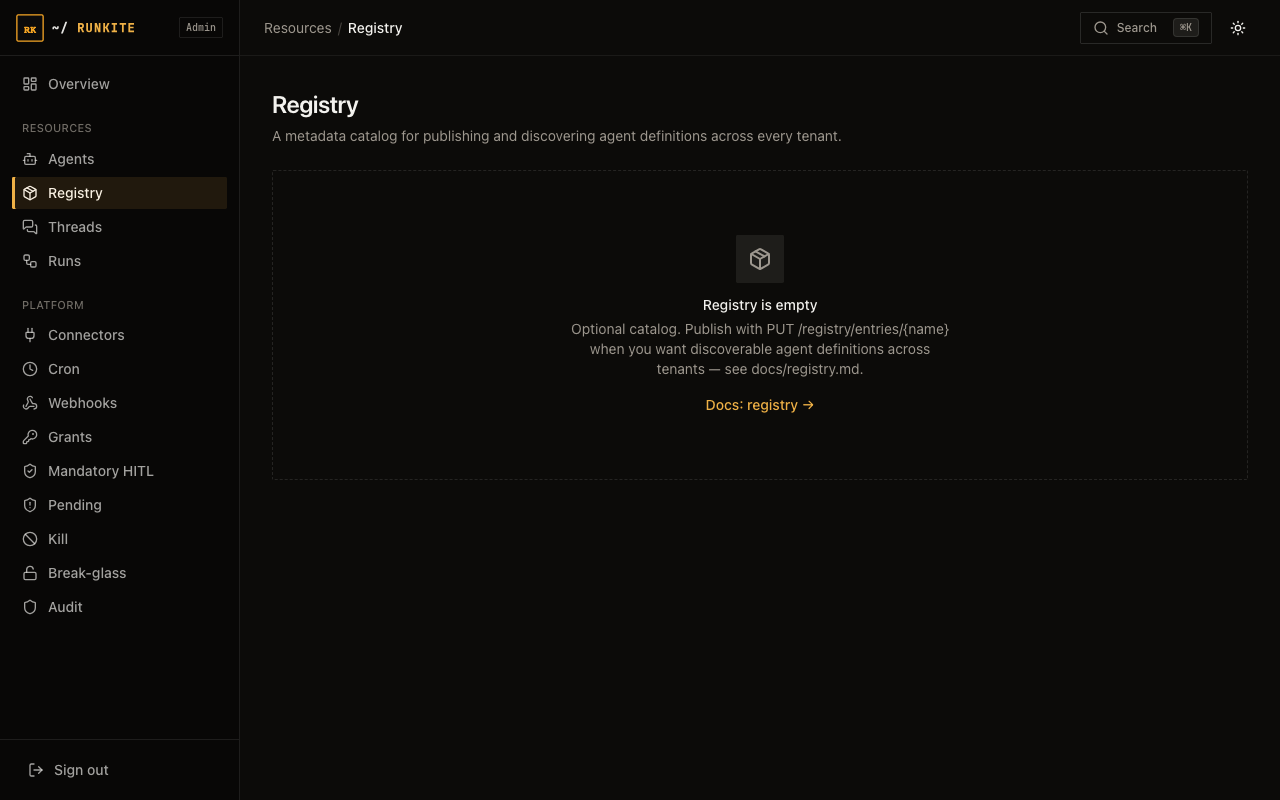
--concurrency Nequals N parallel crews. - Honesty — registry publish ≠ deploy; you still wire runners.
Reference: Framework matrix · Checkpoints · docs/runners.md